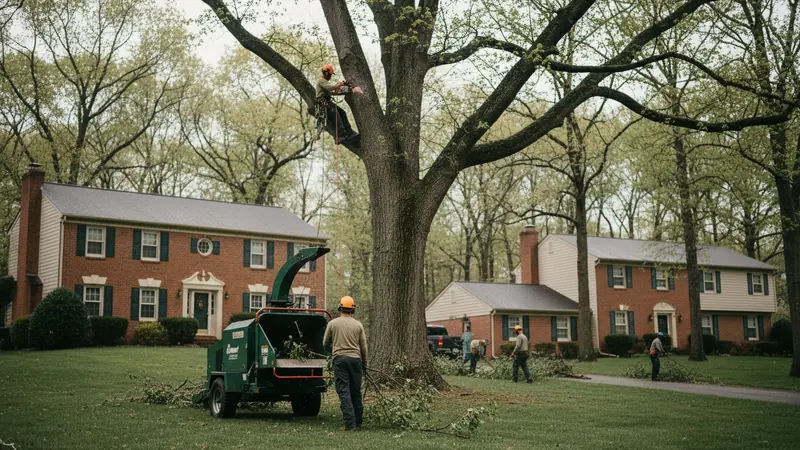
Which trees need permission before you cut them? What does the government charge? What tree problems affect Howard County homes?
We have dated every figure we found. Where a source leaves a price, deadline, or exemption unclear, we say so.
Do you actually need a permit?
Start with where the tree stands. Check your property's records. Different authorities may cover a roadside tree, a fenced garden tree, or protected woodland. That holds even when they all look like part of your garden.
Within a public road right-of-way: Maryland DNR's roadside-tree program requires permission to plant, prune, or remove trees. It covers more than cutting down a healthy street tree. Have the right-of-way identified before you treat a roadside tree as private landscaping. The edge of the mown grass is not a reliable boundary.
Within a forest conservation easement or an approved development plan: check the recorded protections. Howard County requires certain development projects to have an approved Forest Conservation Plan. Its forest-conservation program uses easements to protect retained forest and newly planted forest. Owning the lot does not remove those restrictions.
An ordinary private yard tree outside those protections: we could not find a county homeowner guide settling the permit question. We found none establishing a universal tree-removal permit or a blanket exemption for every residential lot. You cannot assume removal is permit-free just because you own the land. Ask the Department of Planning and Zoning's Planner-of-the-Day, 410-313-2350, whether forest-conservation rules apply to your address and proposed work.
Give that office a marked location. Explain why you want to remove the tree. Share any plat or plan you have. Say whether you only want tree care. An addition, driveway, grading job, or wider clearing project raises different questions.
A permit and the owner's permission are separate. DNR says its roadside permit does not transfer ownership or authorise trespass. Get the tree owner's permission too. DNR requires both owners' consent for a roadside tree straddling properties. Your contractor still needs permission to work on that particular tree, even with a permit.
Source: Maryland DNR Forest Service, Roadside Tree Program and Roadside Tree Law—Application Review Process; Howard County DPZ, Forest Conservation. Undated live guidance; no effective dates stated for these webpages. Gathered 2026-09-22.
The woodland behind the house is not necessarily yard
Howard County describes public open space as land set aside through development. It often contains woods, streams, wetlands, or other sensitive features. The county's Natural Resources staff handle concerns about hazardous trees there. You cannot decide to clear that land or extend your lawn onto it just because you live beside it.
For a conservation easement, get the plat, Forest Conservation Plan, and deed of easement. The plat shows where it is. The plan says what forest must stay or be planted. The deed records the ongoing restrictions. County Recreation and Parks inspects easements. It also investigates violations. You can reach its forest-conservation inspection staff at 410-313-3723.
The county's guide bans clearing, mowing, dumping, composting, and formal landscaping in easements on HOA or county open space. Do not leave your brush pile in protected woodland. Coming from trees does not make it acceptable waste there. The guide says owners and tenants should receive the plan or plat. They should also receive the easement deed's list of allowed and prohibited activities.
If a tree there worries you, ask for that tree to be assessed. Explain the threat to your house or another occupied area. Photograph it from a safe place. Identify the property boundary. Hold off on general woodland cleanup until you know who owns it and what the easement allows.
A misleading document in the county archive. CB64-2021 proposed a separate specimen-tree approval system. It included a notice to proceed for certain removals. It failed. The County Executive's letter of 14 December 2021 records that result in the CB78-2021 legislative file. We have not treated CB64's proposed requirements as law. You still need DPZ to check your parcel's existing easements and development approvals. The failed proposal proves neither a current permit requirement nor an exemption.
Source: Howard County Recreation and Parks, Natural Resources & Park Rangers—Forest Conservation Inspection and Enforcement, undated; Howard County DPZ, Forest Conservation Areas—Public Easements, HOA and County Open Space, undated; Howard County Executive, CB78-2021 veto letter, PDF pages 12–14, dated 2021-12-14. Gathered 2026-09-22.
What the permit costs
The individual roadside-tree permit fee we verified for Howard County is a Maryland charge. It is not a county price for removal. COMAR distinguishes specified work on a tree or group of trees from continuing tree-care programs.
| Maryland roadside-tree permit category | Published fee |
|---|---|
| Specific tree or group of trees, specified work | $25 |
| Continuing program requiring Forest Service supervision | $250 per month per tree-care crew, or $2,500 per year per crew |
| Applicant is a government agency | No permit fee |
| Permit request denied | No fee required under the regulation |
The individual fee is not listed as a per-tree charge. Your private application does not qualify for the government-agency exemption just because the tree stands beside a county road. Your contractor charges separately for arranging permission and doing the work.
Howard County also publishes forest-conservation charges. These apply to its development and conservation program. They are not a standard bill for removing a garden tree.
| County forest-conservation item | Published charge |
|---|---|
| Inspection fee: surety of $0–$100,000 | 0.4% of surety |
| Inspection fee: surety of $100,001–$150,000 | 0.3% of surety |
| Inspection fee: surety of $150,001 and up | 0.2% of surety |
| Minimum inspection fee | $400 for three inspections |
| Fourth and subsequent inspections | Half-fee, minimum $200 |
| Afforestation/reforestation fee within Planned Service Area | $1.25 per square foot |
| Afforestation/reforestation fee outside Planned Service Area | $1.50 per square foot |
| Easement abandonment | $2.00 per square foot |
| Forest-conservation noncompliance | $5.00 per square foot |
How to read the county table. The county lists surety bands and percentages. It gives no worked example showing whether each rate applies to part or all of the surety. We cannot calculate your bill from that alone. The minimum is clear. Ask DPZ to confirm the calculation at 410-313-2350. Paying an abandonment or noncompliance rate does not give you permission to clear an easement.
Source: Maryland DNR, COMAR 08.07.02.04—Types of Roadside Tree Care Permits and 08.07.02.06—Fees, live regulatory text, amendment effective dates not displayed on these sections; Howard County DPZ, Forest Conservation Fee Schedule, effective 2026-07-01, and Forest Conservation contact page. Gathered 2026-09-22.
How long permission and county tree work actually take
We could not find a verified Howard County median permit turnaround. DNR says roadside-tree review times vary with location, the number of trees needing inspection, and application volume. It does not promise approval within a set number of days.
DNR says a Forest Ranger examines the site after it receives your application, fee, and any required site plan. The ranger can approve, change, or refuse the proposed work. They can also ask for more information. Book the work around the permission you receive. An application receipt is not approval.
County maintenance has a separate queue. Howard County says street-tree stump grinding can take up to a year, depending on workload and backlog. That is the county's return visit after it removes a tree. It does not tell you how long a private contractor will take. It is not a permit-review estimate either.
For a forgotten county stump or street-tree maintenance concern, contact the Bureau of Highways on 410-313-7450. In a private quote, give tree removal, stump grinding, and restoring the ground separate entries. Taking down the tree does not tell you what will happen below ground.
Source: Maryland DNR, List of DNR Licenses and Permits—Roadside Tree Permit and Roadside Tree Law—Application Review Process; Howard County Bureau of Highways, Tree Maintenance. Undated live guidance, not service guarantees. Gathered 2026-09-22.
When a broken tree cannot wait
The roadside rule does allow for emergencies. COMAR 08.07.02.03 allows cutting or pruning without a permit when its emergency conditions apply. Those include trees or branches posing immediate danger to a person or property. It also covers uprooted trees or broken branches touching wires.
Whoever provides emergency tree care must tell the Forest Service by telephone or in writing within one week. That notice must identify the location. It must propose any work needed to meet tree-care standards. The Forest Service has two weeks after examining the work to approve, change, or reject that plan. This is not a general two-week permit deadline.
Do not assume every diseased tree qualifies for the immediate-danger exception. Check its status. It does not establish an exception to a separate easement's terms.
For a tree blocking a county road, contact Highways during 8 a.m.–4 p.m., Monday–Friday, as the county advises. Outside those hours, contact police at 410-313-2200. The county warns against email or online reports for urgent blocked roads. You may face a delayed response. Its Highways page directs emergencies to 911.
Keep clear of a tree touching utility lines. The county says to contact the utility responsible for those wires. Emergency permission to prune does not make it safe to approach them.
Source: Maryland DNR, COMAR 08.07.02.03—Permit Required, live regulatory text, amendment effective date not displayed; Howard County Bureau of Highways, Tree Maintenance and Bureau of Highways, undated guidance. Gathered 2026-09-22.
What the inspector is actually going to check
DNR checks proposed roadside-tree work. It also inspects sites to check that the work meets permit conditions. Keep the issued permit available. DNR's application-review guidance requires the tree expert to have a copy on site.
For permitted roadside work, follow COMAR 08.07.02.07 unless the Forest Service grants an exception:
- If you cut back to a live lateral branch, leave one at least one-third the diameter of the severed branch.
- Protect the branch collar when cutting. Do not leave protruding stubs.
- Remove dangerous deadwood and broken limbs covered by the permit.
- Do not use climbing hooks or spurs unless authorised or you are removing the tree.
- Keep chips out of ditches, waterways, turf, and surfaced areas in the right-of-way. Spread them no deeper than 6 inches.
- You may have to plant a replacement after removal.
Underground projects have root-protection rules too. You need Forest Service approval to cut roadside roots 1 inch or larger. A driveway or utility trench may therefore need attention even if you are leaving the trunk alone.
These roadside rules do not mean every private garden pruning job gets a county final inspection. In conservation easements, the county enforces the recorded plan and restrictions. We found no universal county inspection sequence for ordinary tree care at private homes.
Source: Maryland DNR Forest Service, Roadside Tree Program, Application Review Process, and COMAR 08.07.02.07—Roadside Tree Care Standards; Howard County DPZ, Forest Conservation—Inspections and Enforcement. Web guidance undated; COMAR amendment effective date not displayed. Gathered 2026-09-22.
Who is allowed to do the work
Check for a Maryland Licensed Tree Expert credential, issued through DNR. DNR's consumer guidance includes trimming and removing damaged or fallen trees. It says the company should have a licensed expert on staff. The licence number must appear on its vehicles.
A number painted on a truck is only a starting point. DNR warns that businesses sometimes display false numbers. You can search its public lookup by company, county, or licensee name. Match the person doing your job to the state record. Check the business too. Do not rely on a vague claim of being licensed and insured.
DNR says supervised employees do not each need their own licence. Licensees must maintain liability and property-damage insurance. They must report which companies work under their licence. They must also report their insurance information. Ask which licensed expert is responsible for your crew. Request current insurance documents for the business named on your contract.
For disease treatments, check pesticide credentials separately. Maryland Agriculture's beech-leaf-disease guidance directs you to licensed and certified pesticide applicators for treatment options. Removing a tree is different from treating it with pesticides. Check that the paperwork says which work you are being offered.
Source: Maryland DNR, Marylanders Hiring Tree Service Contractors Should Always Verify Credentials, published 2025-05-30; Licensed Tree Experts and license lookup, undated; Maryland Department of Agriculture, Beech Leaf Disease announcement, published 2025-06-09. Gathered 2026-09-22.
When tree work becomes a development project
Clearing your lot for a new use needs a different review from removing a damaged limb.
Howard County still links a single-residential-lot form titled Clearing Less Than 20,000 Square Feet of Forest. You must make a declaration. It covers a five-year period. It excludes forest already protected by an approved Forest Conservation Plan. It does not let you clear that area anywhere on a residential property.
An old form with wording worth checking. The linked form was revised November 2009. Its title and off-site-clearing note say less than the threshold. Its declaration says not more than the threshold. We have taken the stricter reading: less than. We could not establish current eligibility from the form alone. Ask DPZ whether it applies to your project at 410-313-2350. Have them check the boundary case before you rely on it too.
Check the newer policy too. DPZ's memorandum dated 2 July 2026, effective 1 July 2026, puts state forest-conservation changes into practice. Local ordinance and manual amendments are still pending. For proposed clearing in a priority forest-retention area, abutting and adjacent owners must receive notice. That must happen at least 20 days before Forest Conservation Plan approval. The memorandum also requires planting in unforested stream and wetland buffers, with stated exceptions. It sets conditions for projects to stay under older rules too.
That notice period applies to the specified development review. It does not establish a waiting period for every homeowner who needs a storm-damaged tree removed. For construction, check that your designer and tree contractor use the same approved limits of disturbance. Check that they follow the same tree-retention requirements too.
Source: Howard County DPZ, Single Residential Lot Exemption Declaration of Intent, revised 2009-11 and still linked by the county; Maryland SB526 (2023) and Required Forest Conservation Program Changes, memorandum dated 2026-07-02, effective 2026-07-01; Forest Conservation contact page. Gathered 2026-09-22.
What goes wrong with trees around Howard County homes
We found evidence of specific local problems. We could not establish what percentage of residential trees need removing. We also could not establish which species accounts for the most homeowner claims. We found no such countywide figures.
Ash decline has a documented local history. Maryland Agriculture announced Howard County's first confirmed emerald ash borer detection on 14 June 2011. It had been discovered earlier that month. The account describes thinning and dieback in the upper crown. Other signs include shoots below dying portions, D-shaped exit holes, bark splits, and winding galleries beneath the bark. Have your ash assessed if you see these signs. Do not assume a thinning crown only needs pruning.
Can your tree stay with treatment, or does it need removing? That depends on its species, condition, and location. A foliage photograph alone cannot settle the risk to a roof, driveway, or seating area. The historical announcement confirms local presence. We have not treated its old quarantine instructions as current transport rules.
Beech leaf disease is also confirmed here. Maryland Agriculture's 9 June 2025 announcement includes Howard County among counties with worsening symptoms. Signs include striping, curling, leathery leaves, and fewer leaves and buds. You can see symptoms best from below the leaf. The disease affects native and ornamental beeches. It can kill them.
If your beech has become sparse, ask for a diagnosis before paying for repeated cosmetic trimming. The state discusses treatment options. We cannot promise a cure, a county-specific survival percentage, or a fixed remaining lifespan for your tree. Record the symptoms. Have a suitably qualified professional assess the tree. Ask them to assess any proposed treatment too.
Vines at the woodland edge deserve attention too. Howard County's Tree Savers program removes invasive vines from native trees on parkland. Its forestry page has resources to help you identify vines. It also demonstrates the window-cutting method. The program shows that invasive vines are a local problem. It does not prove every vine-covered tree is dying.
If you live beside open space, identify the vine before you arrange work. Find out who owns the land too. The county provides designated volunteer locations. You need permission for other county sites. Removing invasive growth is different from turning the wooded edge into lawn. They have different consequences for protected land.
Source: Maryland Department of Agriculture, Emerald Ash Borer Found in Howard County for the First Time, published 2011-06-14, used for detection history and symptoms only; Worsening Conditions of Beech Leaf Disease Confirmed Throughout the State, published 2025-06-09; Howard County Recreation and Parks, Forestry—Tree Savers, undated live guidance. Gathered 2026-09-22.
What the work is worth, and what a quote needs to say
We could not find primary-source data on Howard County prices for residential tree removal, pruning, stump grinding, or emergency response. We have no reliable county average to compare with your quote. Government charges cannot tell you what a contractor will charge.
DNR recommends getting several estimates. It also advises getting a written contract specifying the work and cost. To compare quotes in this county, describe the tree and the full job:
- Identify each tree. Say whether you want it pruned, treated, or removed.
- Settle who checks the right-of-way, easement, and owner's permission. Name who will get any required authorisation.
- State whether brush, logs, and chips will leave your property. Agree where equipment will travel.
- List stump grinding separately from taking down the trunk. Give any soil or lawn repairs their own entry too.
- Identify any required replacement planting. Settle who supplies it. Agree who maintains it.
These are suggestions for your contract, not county prices. You cannot judge value from the totals if the quotes cover different work. DNR also advises you not to pay in full before the contracted work is finished.
Source: Maryland DNR, Marylanders Hiring Tree Service Contractors Should Always Verify Credentials, published 2025-05-30, for estimate, contract, and payment guidance. Scope checklist is an application of the sourced requirements above; no local job-price dataset was found in the primary sources reviewed. Gathered 2026-09-22.
The short version
- Before you authorise routine work, find out who owns the tree. Check whether it stands in a right-of-way. Check its recorded protections too.
- Roadside work generally needs DNR permission. The individual permit fee is $25.
- Conservation woodland is not spare garden or somewhere to dump tree debris.
- Check your responsible Maryland Licensed Tree Expert in the state lookup.
- Ash borer and beech leaf disease are documented Howard County problems. Base the work on a diagnosis and your tree's condition.
- We could not verify a local average job price or median permit turnaround.
Source: Maryland DNR, Roadside Tree Program, COMAR fee rule, and license guidance; Howard County forest-conservation guidance; Maryland Agriculture's 2011 ash-borer and 2025 beech-leaf-disease announcements, linked above. Gathered 2026-09-22.