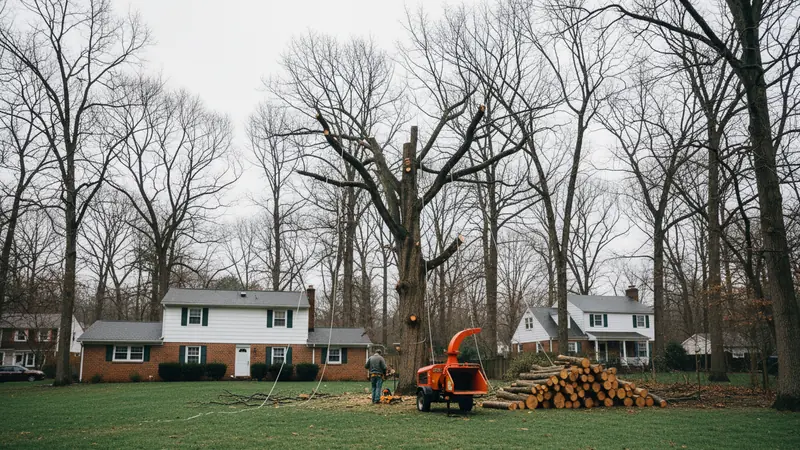
Does the tree need to go? How will you protect the trees you keep? Who takes the logs and stump Howard County will not collect?
Does the whole tree need to come down?
A broken limb does not automatically mean the tree must go. Ask the tree expert what could fail. What could it hit? Why would pruning not solve the problem? University of Maryland Extension draws a distinction here. A tree near people or property may be hazardous. A dying tree in a natural area may safely stay as wildlife habitat.
Howard County's street-tree crews have removed apparently healthy ash trees because of emerald ash borer. Ask how your tree's condition affects the work. Extension warns that ash killed by the insect becomes brittle. Even experienced professionals can struggle to remove it. Waiting for more branches to fall will not make the job simpler.
Have the expert inspect the trunk and base, not just the leaves. Extension flags severe trunk damage, decay, and a sudden lean as reasons for concern. Describe recent trenching or driveway work too. Ask for a written reason for removing the tree shown in the estimate. “Bad tree” is not enough.
Source: University of Maryland Extension, How Do You Decide When to Remove a Tree?, updated 2023-05-18, no separate effective date; Howard County Bureau of Highways, Tree Maintenance, undated guidance, no effective date stated. Gathered 2026-09-23.
How will the crew take it down?
Before you sign, ask how the crew will take the tree down. Will they fell it into open space? Or take it apart using ropes or lifting equipment to control the pieces? Ask why that method suits your roof, fence, driveway, nearby trees, and overhead wires. If the estimate includes a crane, ask where it will stand. What access will it need?
OSHA's tree-removal guidance covers falls, falling wood, electrical hazards, and moving vehicles. It warns that insect damage can make climbing more hazardous than using a crane. A method that suits a sound tree may not suit a decayed one.
Ask where you need to stay while the crew works. Can you still use the driveway or an exterior door? Let the crew set the work area's boundaries. Leave them in charge of it. Do not go in to move branches yourself.
If wires run through the canopy, Howard County says to contact the responsible utility about tree concerns. Before you agree a work date, settle who will speak to that utility. Keep clear of any tree touching wires.
Source: U.S. Occupational Safety and Health Administration, Inspection Guidance for Tree Care and Tree Removal Operations, memorandum dated 2021-06-30, no separate effective date; Howard County Bureau of Highways, Tree Maintenance, undated, no effective date stated. Gathered 2026-09-23.
Plan the route without sacrificing the trees you keep
You can read about permits and protected woodland in the county tree-service guide. Mark those boundaries on the crew's access plan. Mark the tree to be removed. Show the equipment route. Mark where the crew will load logs. Howard County's forest-conservation plans set out protections for before, during, and after development. Recorded easements still limit what you can do afterwards.
Ask whether the proposed route crosses an easement or someone else's land. If it does, settle access before you agree to that route. An open strip behind the fence does not mean the crew may drive there.
Protect nearby roots as well as trunks. Extension explains that digging can cut through roots. Compacted soil can also harm a tree's health. Damage may not show up straight away. Ask how the crew will protect the ground. How will they avoid digging around trees you keep, including when they return for the stump? Photograph the route beforehand. Agree who repairs disturbed lawn, fencing, or paving.
Source: Howard County Recreation and Parks, Natural Resources & Park Rangers—Forest Conservation Inspection & Enforcement, undated guidance, no effective date stated; University of Maryland Extension, Damaged Tree Roots, updated 2023-02-27, no separate effective date. Gathered 2026-09-23.
What should the removal price cover?
We could not find a primary-source Howard County average for private residential tree removal, crane work, or stump grinding. The county guide's permit charges do not tell you what a contractor should charge for your tree.
Compare written prices for the same finished result. Ask each bidder to identify the tree. Does the price cover taking it down? Loading the wood? Hauling it away? Dealing with the stump? If you want logs for firewood, say where to leave them. Say how you want them left. Do not assume that leaving wood means a particular discount.
Ask whether equipment, hauling, and disposal charges are included or billed separately. If anything will be priced later, ask how the charge will be worked out. Agree it in writing before extra work starts. We suggest these contract terms. They are not a county price formula.
Maryland DNR recommends that you compare estimates. Use a written contract stating the work and cost. Hold back full payment until the agreed work is complete. Follow the county guide's licence check for the business named on your contract.
Source: Maryland DNR, Marylanders Hiring Tree Service Contractors Should Always Verify Credentials, published 2025-05-30, no separate effective date. Contract questions apply that guidance to removal work; no county job-price dataset was found in the primary sources reviewed. Gathered 2026-09-23.
Will Howard County take the debris?
“Leave it at the curb” is not a complete clean-up plan. Howard County will not collect stumps with curbside yard trim. It limits the branches and bundles it accepts. If your home receives that service, these are the published limits:
| Material or container | County limit |
|---|---|
| Individual small limb or branch | Less than 4 inches in diameter and 4 feet in length |
| Tied brush or branch bundle | No more than 4 feet long and 18 inches in diameter |
| Container, paper bag, or bundle | Less than 40 pounds |
The county accepts no plastic bags for yard trim. If the quote leaves you to arrange curbside pickup, ask who cuts eligible branches. Ask who bundles them. Large trunk sections need to go elsewhere.
Alpha Ridge's Wood Waste Area accepts logs and stumps as well as branches. Commercial customers need an active commercial landfill permit. Keep broken fence boards and other timber separate. The county sends that material to the Transfer Station. If a tree crushed your fence, the debris on your lawn may need to go to different places.
Source: Howard County Bureau of Environmental Services, Yard Trim Collection and Wood Waste Area, undated live guidance, no effective dates stated. Gathered 2026-09-23.
Settle disposal charges and the stump before the crew leaves
Alpha Ridge publishes these charges for clean wood and yard trim. They cover disposal. They do not cover the crew's labour or hauling:
| Delivery category | Published charge |
|---|---|
| Residential clean wood/yard trim within the fiscal-year allowance | No charge up to 2 tons |
| Residential clean wood/yard trim above that allowance | $40 per ton in excess |
| Commercial clean wood/yard trim | $40 per ton |
Do not assume a contractor can use your residential allowance. The landfill treats you as commercial if you arrive with a trailer, dump truck, box truck, or rental vehicle. You must cross the scales. Fees may apply.
Before you accept the finished job, compare the yard with the contract. If stump work is included, confirm when it happens. How far does the agreed work extend? Who takes the grindings? Who leaves the ground ready for what you want to do with it? Tell the contractor if you plan to replant or build there before you agree the stump work. “Tree removed” alone does not answer those questions.
Source: Howard County Bureau of Environmental Services, FY27 Alpha Ridge Landfill User Fees and Charges, effective 2026-07-01 through 2027-06-30; Alpha Ridge Landfill, undated vehicle guidance, no effective date stated. Stump questions are suggested contract checks. Gathered 2026-09-23.